







What are dentures?
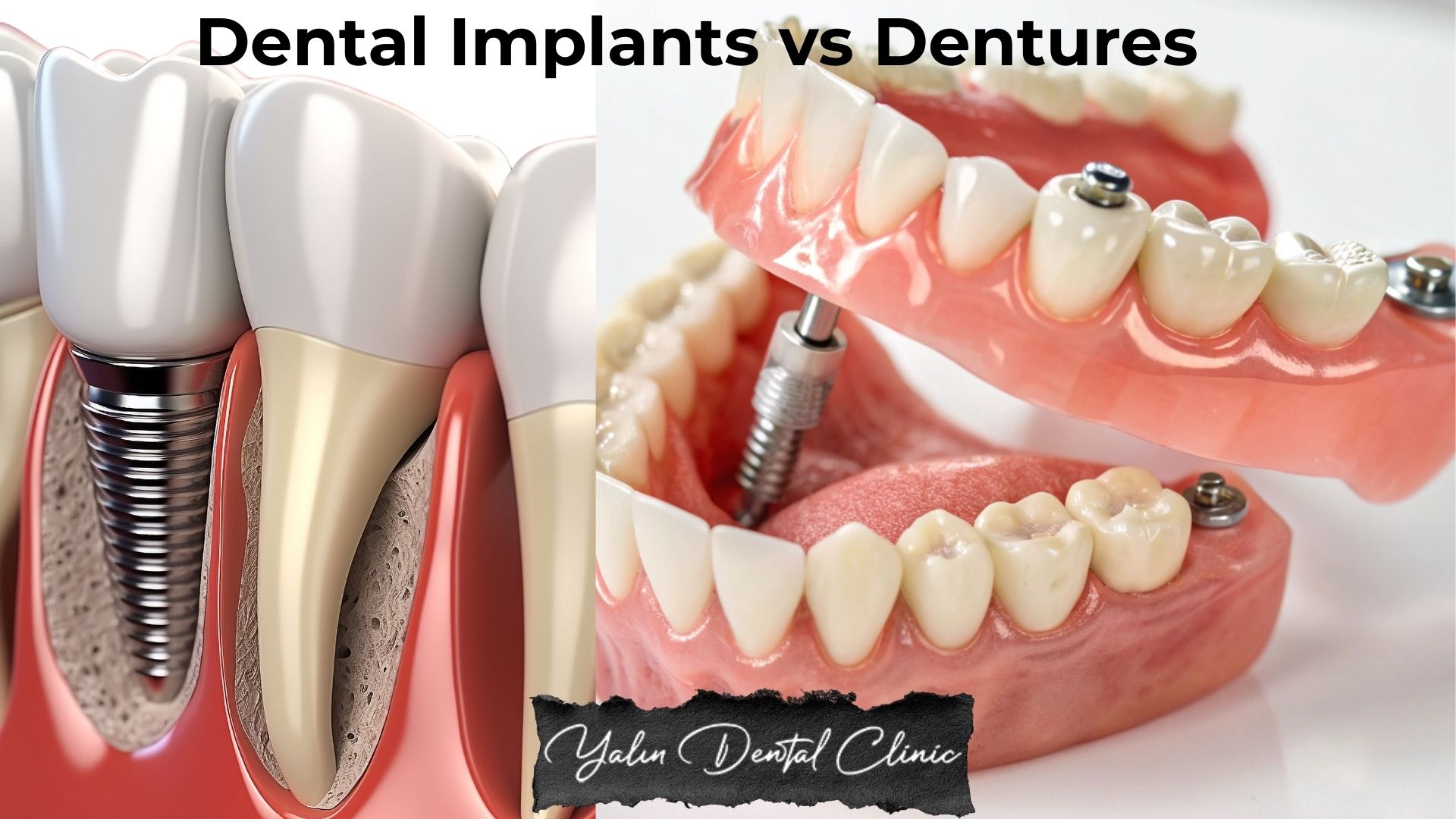
Dentures are tailored, detachable devices that serve as a substitution for teeth and the adjacent gums in patients who have gone without a single to multiple permanent teeth. Based on how many teeth have been lost, these may be used as complete dentures or partial dentures.
What is a dental implant?
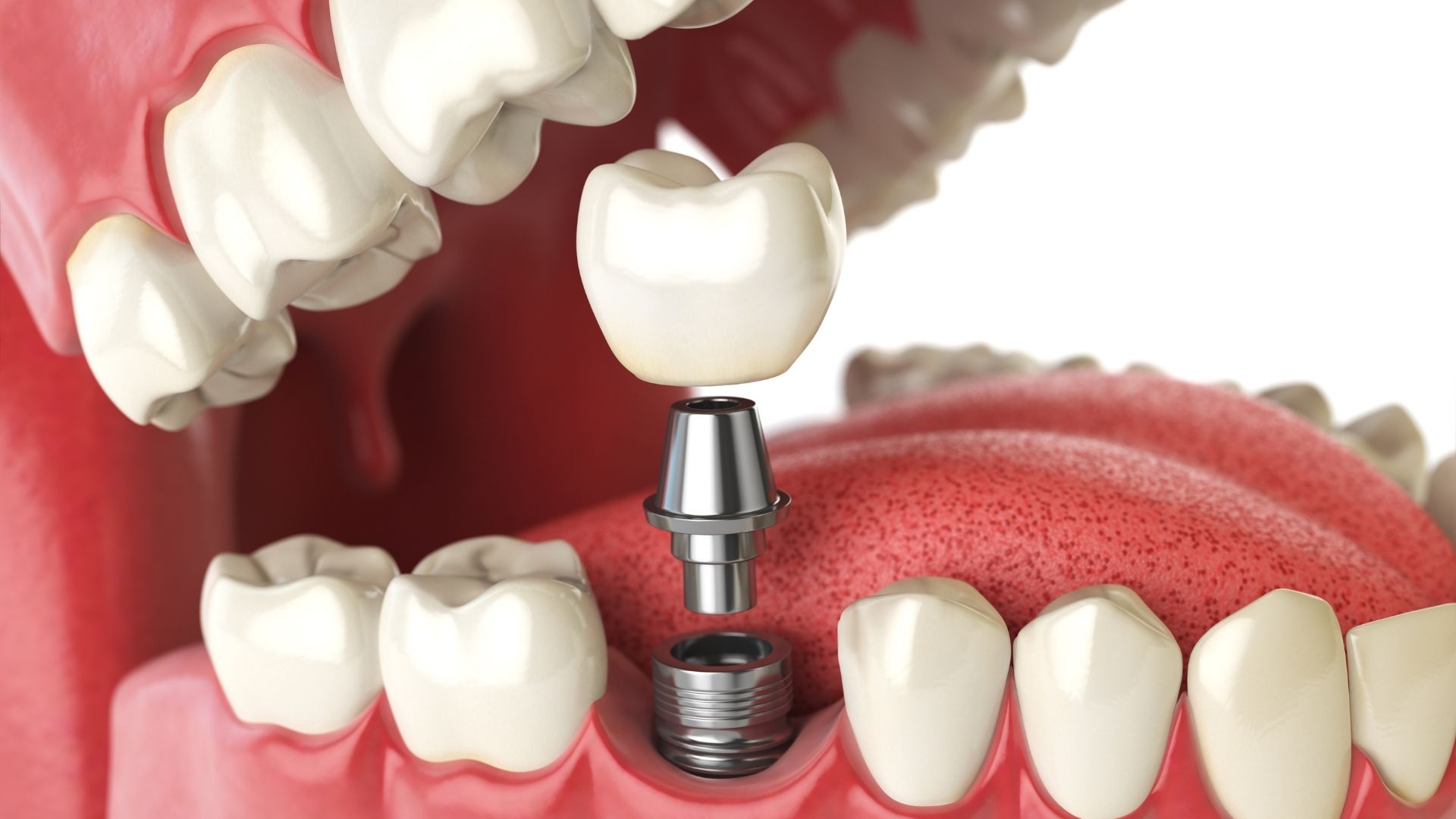
A dental implant is a small screw made of a biocompatible material such as titanium which may be used to replace the root of a missing tooth. These screws are surgically installed into the jawbone under the gum tissue and thus provide a firm base for the artificial teeth (crowns), bridges, or dentures to be connected to.
Types of Dentures
There are different types of dentures based on how many teeth you lost and how you use them.
Removable dentures, also called traditional dentures
The user can take these dentures off at any time because they sit right on the gum tissue.
Full dentures:
These are used when all of the teeth in the mouth are gone. They are made up of fake teeth on a base that looks like gums, and they stay in place in the mouth because of suction.
Partial dentures:
Partial dentures are best are best when some of the person's own teeth are still in their mouth. These dentures have metal clasps that hold them to your teeth.
Removable dentures that are held in place by implants (overdentures)
These dentures are attached to implants with snap-like mechanisms, but the patient can take them off.
Full dentures that are supported by implants (overdentures):
They are usually put on two to four implants. They are much more stable and comfortable than regular full dentures, and they don't slip or fall out of the mouth.
Implant-supported partial dentures (ISRPD):
These make partial dentures more stable by linking the implants to the roots of the natural teeth. This method keeps the denture from moving to the side, which is especially important for people who have lost teeth in the back.
Dentures that are supported by mini-implants:
If there isn't enough bone volume, smaller-diameter mini-implants can be used to hold existing dentures in place.
Fixed dentures that are supported by implants (Hybrid dentures)
A dentist can only take these dentures off of the implants.
- Fixed detachable implant dentures (FDIP): These are also known as "hybrid dentures." They are made by putting acrylic or porcelain teeth on a metal, zirconia, or PEEK (high-performance polymer) substructure.
- All-on-4/6: Full arch bridges that are fixed to 4 or 6 implants to replace all of the teeth in the jaw. This system doesn't cover the palate like traditional dentures do, which makes it easier to taste and speak.
Types of Dental Implants
Depending on their form, surface features, methods of use, and aims, dental implants can be classified into different types. These are the main distinctions:
Dental implants by shape and structure
Cylindrical implants:
- This type is the one which is most used. It has the shape of a root and a screw.
- They are inserted into the bone of the jaw (mandible/maxilla) like a screw.
- Their surface is made rough (sandblasted or acid, etched) which leads to a very high osseointegration (fusion with the bone) rate.
Conical implants:
- They have a pointed tip and a conical structure.
- They are used particularly in areas with reduced bone density or after tooth extraction.
- They provide better primary stability.
Blade implants:
- They are thin, flat, leaf-shaped metal pieces.
- They are used in narrow bone areas.
- They are not as common as screw implants and have relatively lower stability.
Dental implants according to application protocols:
Two-stage (traditional) implant:
First stage: The implant is inserted into the bone of the jaw and covered with gum. The implant is left to fuse with the bone for 3, 6 months.
Second stage: The gum is incised, an abutment (connecting element) is fixed to the implant, and an impression is taken in order to make the superstructure (crown/denture).
Single, stage implant:
After the implant is inserted, it is left uncovered by gum tissue. The head of the implant is accessible in the mouth. Only the superstructure is made at the end of the waiting period; a second surgical operation is not necessary.
Immediate loading:
- A temporary tooth (crown/denture) is installed on the same day as the implant surgery.
- Very strict criteria are necessary for this: excellent bone quality, enough primary stability, and a special implant design are absolutely indispensable.
- Mostly it is used in the anterior or region (aesthetic region) for single teeth or in such All, on, 4 type of protocols.
Dental implants according to their intended use
All-on-4 / All-on-6 (Full Denture Alternative):
- This is a specially designed protocol that is used to produce a fixed denture for a jaw without any teeth.
- Four or six implants are placed at the certain angles, and then a full bridge with 12, 14 teeth is permanently attached to them.
- Usually, the posterior region is where the angled implants are inserted so as to be able to do without bone grafting (additional bone).
Zygoma implant
- For patients, whose upper jaw bones have deteriorated severely, this kind of implant is used.
- The extremely long implant reaches the cheekbone (zygomatic bone), where it is fixed.
- It is a highly advanced surgical procedure.
Mini implants:
- Their diameter is smaller than that of standard implants (usually less than 3 mm).
- With the help of them, temporary supports or removable dentures (overdentures) can be more retained.
- They serve as a source of low bone volume area or can be small teeth (incisors) that are replaced. They do not carry the same load as standard implants.
Basal implants:
- In contrast to regular screw implants, they are inserted deeper in the denser parts of the jawbone (basal bone).
- Sometimes, it is possible that they do not need any bone grafting, and in most cases, they can be loaded right away (within 48 hours).
- The method here is more specialized.
Dentures and Implant Pros and Cons

Dentures: pros and cons
Pros of dentures
- Lower initial cost: Much more economical than implants.
- Short treatment time: Can usually be completed within a few weeks.
- Does not require surgery (generally): Measurements are taken once the gums have healed after extraction.
- Can be used even in completely edentulous patients: Can be used even if there is insufficient bone.
- Ease of repair and adjustment: They are relatively easy to repair in case of breakage or impact.
Cons of dentures
- Stability: Particularly, in the lower jaw, the retention may be very weak, thus, slipping and falling out can be expected.
- Accelerates bone loss: The bone under the pressure of the denture gradually becomes thinner and weaker.
- Low chewing efficiency: Only 20, 25% of the chewing power of natural teeth is provided. Hard and sticky foods are difficult to chew.
- Feeling of fullness in the mouth and reduced sense of taste: If the palate is covered, the tasting of food may not be done completely.
- The adjustment period may be difficult: Speech problems, gag reflex, and excessive salivation may be experienced.
- Have to be taken off at night: Should be cleaned every night, and the mouth should be rested.
- They become worn over time and have to be replaced: On average, it is recommended to be replaced every 5, 7 years.
Dental implants: pros and cons
Pros of dental implants
- Function and feel like natural teeth: This is the biggest advantage. Chewing efficiency is close to that of natural teeth.
- Prevents bone loss: The force exerted on the implant stops or slows down bone resorption.
- Does not damage neighboring teeth: Unlike bridge dentures, there is no need to cut the adjacent teeth.
- Excellent retention: As it is fixed, it does not move or slip.
- Long-lasting: With good oral care, it can be used for life.
- Aesthetic and psychological comfort: It looks natural, and the patient feels as if it is their own tooth.
Cons of dental implants
- High cost: The expense of the treatment and materials is significantly more than that of dentures.
- Necessitates surgery: A local anesthetic operation is performed.
- Extended treatment period: The implant takes 3, 6 months to fuse with the bone (osseointegration).
- It may not be a condition that every patient can be suitable for: Uncontrolled diabetes, using bone loss medication (bisphosphonates), smoking excessively, and a lack of bone may be your obstacles.
- Surgical risks: There are very few risks such as infection, nerve damage, and sinus problems (upper jaw).
- Proper oral hygiene is a must: Regular and efficient cleaning is necessary to keep the implant area free from infection (peri, implantitis).
Compare of Dentures and Dental Implant
|
Dentures (Removable) |
Dental Implants (Fixed/Bridge or Implant-Supported) |
|
Type of Treatment: |
|
|
Look, Feel/Functionality: |
|
|
Treatment Time /Daily Care: |
|
|
Longevity / Durability: |
|
|
Aftercare /Maintenance: |
|
|
Cost: |
|
|
Suitability: |
|
Cost of denture and implant
Denture costs
Low initial cost: Conventionally, removable dentures are less expensive and more budget, friendly solutions than dental implants at the first instance.
Ongoing expenses: Dentures, although cheap at the beginning, must be kept in good condition for a lifetime and so, will always require some maintenance costs.
Requirement for replacement: The duration of use of dentures and bridges is normally 5, 10 years. As a result, it implies that re, covering or completely changing is needed every several years which, therefore, elevates the total cost.
The cost of dental implants
Expensive at the beginning: Implant treatment is a more expensive procedure at the beginning.
The factors that influence the price: The total treatment fee changes according to the number of teeth to be replaced, the type of restoration (fixed or removable) chosen, if additional surgical procedures like bone grafting are needed, the specialist's time, and laboratory fees.
Cost, effectiveness over time: Implants are made to last for a lifetime with good maintenance and thus are more cost, effective than other alternatives in the long term. As a matter of fact, when dentures have to be replaced every 5, 10 years, implants give you the benefit of being a one, time investment.
Average prices:
|
Treatment (€) |
Turkey |
UK |
Germany |
|
Full Acrylic Denture (per jaw) |
200 - 400 |
400 - 800 |
500 - 1,000 |
|
Premium Flexible/Cobalt-Chrome Den-ture (per jaw) |
400 - 800 |
1,000 - 2,000 |
1,200 - 2,500 |
|
Single Dental Implant (Implant + Abutment + Crown) |
700 - 1,500 |
2,500 - 4,000 |
2,000 - 3,500 |
|
All-on-4 / Full Arch Implant Solution (per jaw) |
4,000 - 8,000 |
15,000 - 25,000+ |
12,000 - 20,000+ |
|
Implant-Supported Bridge (3 teeth on 2 implants) |
2,000 - 3,500 |
6,000 - 10,000 |
5,000 - 9,000 |
|
Bone Grafting (per site, if needed) |
200 - 500 |
500 - 1,200 |
400 - 1,000 |
Should I choose dental implants or dentures for missing teeth?
The choice between dental implants and traditional dentures for treating missing teeth depends on your overall health, jawbone volume, budget, and quality of life expectations.
The following key comparisons will help you make your decision:
Why choose dental implants?
- Promotes bone health: Implants basically simulate natural tooth roots as they continue to stimulate the jawbone and therefore are the only device that stops bone resorption. It is estimated that the wait after tooth extraction can lead to the loss of 25% of the bone within the first year.
- Better than natural: Implants can bring back about 90% of the chewing power while normal dentures can only give 20, 25% of the power. In other words, with implants, you can eat hard foods like steak or apples without any problem.
- Forever: Implants are made in such a way that they can stay for a lifetime if proper care is given to them. Dentures, however, generally have to be renewed or relined every 5 years.
- Satisfaction and self, esteem: Implants do not move around in the mouth, there is no need for glue, and no sound is produced when talking.
Why choose dentures?
- Cost: At the beginning, dentures will be a less expensive and more wallet, friendly option as compared to implants.
- Circumstances in which a surgical operation is avoided: In case of patients' refusal of a surgical operation, dentures constitute an answer rapid enough to meet their needs. Moreover, the health condition of a patient (e. g. , diabetes not under control) can also be a reason that makes surgery inappropriate.
- Not enough bone: Individuals with an insufficient and weak jawbone or gums may use dentures as a solution.
How does denture work?
The working principle of dentures is as follows:
Retention and vacuum mechanism
Full dentures rely primarily on vacuum to remain fixed in the mouth.
Upper jaw: Upper dentures cover the large surface of the palate and thus create a suction effect. The post dam or the area at the back of the denture coming into contact with the soft tissue creates an airtight seal and prevents the denture from falling out.
Role of saliva: A very thin layer of saliva between the denture and the gums is responsible for surface tension, which is the main reason for the strength of this vacuum. Lack of saliva (dry mouth) is one of the main causes of the denture retention problem.
Partial dentures: In case of some natural teeth in the mouth, the denture is fixed by metal clasps or precision attachments which are attached to these teeth thus securing the denture in place.
Distribution of chewing force (Support)
- While natural teeth allow the bone to take the chewing force directly through their roots, traditional dentures press this force into the gum tissue.
- Dentures are supported by the bony ridge under the gums (alveolar crest) and spread the chewing pressure through this soft tissue to the bone.
- Thus dentures have a considerably lower chewing capacity (5, 25%) than natural teeth, since the gums can become sore if very high pressure is applied or the dentures can get loose.
Stability and biomechanical balance
- This is the ability of a denture to resist movements in different directions. The height of the jawbone and the precision of the denture teeth alignment (occlusion) are the main factors, on which this depends.
- When the jawbone resorbs, the surface that supports the denture becomes flatter and stability is lost; hence, the denture will be loose.
What is Snap-in dentures?
Snap-in dentures are a type of removable overdentures made for being firmly fixed to dental implants. The denture in this system is not, as in traditional dentures, held by suction to the gums but by mechanical attachment components placed on implants inserted into the jawbone.
The main features of snap-in dentures are as follows:
- Connection mechanism: The metal casings that are inserted into the denture snap onto the component that is on the top of the implant (generally an O, ball or locator type) with a click sound. This link stops the denture from moving while using it but gives the user an option to take off the denture to clean it whenever they want.
- Implant support: In most cases, two or more standard or mini implants are used to provide the necessary stability in the lower jaw. Minimized implants may be able to deliver a fast remedy with less surgical intervention in a condition where the bone volume is insufficient.
- Adaptation of existing dentures: Sometimes it may be possible to transform the patient's existing traditional denture into a snap, in system just by attaching the necessary connecting pieces (retrofitting).
- Advantages: It makes possible to stabilize and retain the prosthesis to a great extent, compared to a traditional denture. Thus the chewing capacity is increased, the fear of slippage during speech is eliminated and the use of denture adhesives is reduced. What is more, a more open design of the palate can be made, which has the potential to enhance the sense of taste.
- Quality of Life: Patients state that they feel more secure with snap, in dentures and thus do not have the concern of their dentures falling out when they are in socializing situations.
What are the alternatives to dentures and implants?
The main methods that can be considered as alternatives to dentures and dental implants for the treatment of missing or damaged teeth are, according to sources, as follows:
Fixed bridges
- This is the most common alternative for patients who are unwilling to have implants or removable dentures.
- The natural teeth on both sides of the empty space are shaved to hold a bridge structure, and the artificial tooth in the gap is fixed to these teeth.
- On average, traditional fixed bridges have a lifespan of 7 to 10 years. Some studies show that this period can be as long as 10, 20 years, but eventually, they have to be replaced.
- They need the removal of healthy neighboring teeth, which can threaten the future health of those teeth. In addition, unlike implants, they do not prevent bone resorption in the jawbone.
Resin-bonded bridges (Maryland bridges)
This is a less invasive type of bridge.
It is applied by bonding the artificial tooth to the back surface of the adjacent teeth with resin, without the need to completely cut the adjacent teeth.
Root canal treatment and restoration (Endodontic treatment)
- If the tooth is still intact but heavily damaged, it is a different way to remove the tooth and implant/denture that aims at saving the tooth.
- The nerves of the diseased tooth are taken out, the hollow part is cleaned, and a crown (cap) is put on the top.
- It is indicated that the success rates of root canal treated teeth in the short term are on a par with those of implant, supported crowns. In any case, it may always be possible that depending on the condition of the broken tooth, saving it will be the first option instead of extracting it and placing an implant.
All-ceramic restorations
- In particular, they provide a visually pleasing option, especially in case of a single tooth loss or damage in the front area.
- They possess a reasonable lifespan for single, rooted anterior teeth and full crowns; however, the long, term survival rate of posterior molars might be lower.
Frequently Asked Questions
Which is better, dentures or dental implants?
Dental implants are a better option because they offer the closest comfort, functionality, and aesthetics to natural teeth. As they are fixed, they do not slip, cause problems when eating or speaking, and have the potential to be a lifelong solution.
However, removable dentures are also a valuable and suitable treatment for many patients. Dentures can be an accessible, quick, and successful option, especially for patients who are unable to undergo surgery, do not have sufficient bone support, have a limited budget, or are looking for an urgent/temporary solution.
Do implants look more natural than dentures?
Dental implants generally provide a much more natural appearance than removable dentures. The main reason for this is that each implant has a crown that emerges individually from the gum tissue and is fully compatible with the adjacent natural teeth. Since there are no wide acrylic plates covering the palate, as in dentures, the gum line appears much more realistic.
Furthermore, because implants are fixed and prevent bone loss, they preserve facial shape and smile aesthetics over the years; with dentures, however, bone loss over time can lead to a sunken mouth appearance, and dentures may give the face a fuller appearance.
Is it easier to eat with dentures or implants?
Eating is much easier with dental implants. Implants provide chewing power close to that of natural teeth (90%+), allowing you to comfortably and confidently eat foods such as apples, hard bread crusts, steak, and nuts. Because they are fixed, they do not move, slip, or cause pain, and because they do not cover the palate, you can fully enjoy the taste of your food.
In contrast, eating with removable dentures imposes serious limitations. Chewing efficiency is low (20-30%); lower dentures in particular can slip, and hard and sticky foods cause problems. Food can get trapped under dentures, and they may need to be removed and cleaned frequently. In short, while implants restore the pleasure of eating with almost no restrictions, dentures require constant caution and attention in one's diet.
Please contact us for more information.